On the second day of my Kyushu road trip, I left Nagasaki behind and drove into Kumamoto. After the long stretch on the open road, the city felt different right away—more grounded, more deliberate.
Vintage trams share Kumamoto’s streets with cars. Therefore, slow down when driving a rental car through the center. In addition, pay close attention to lane markings, turn signals, and tram lights. I eased off the accelerator almost instinctively upon entering the city.
I visited Kumamoto Castle with one main question: how did it look after the 2016 earthquake? Actually, Kumamoto works perfectly as a calm half-day stop. It fits seamlessly before you head toward Mount Aso the next day. The area around the castle is enough to fill an afternoon with history, reflection, and just enough movement to make you feel you have truly arrived somewhere.
A Gentle Start at Sakura-no-Baba Josaien
Before heading up to the castle, I stopped at Sakura-no-Baba Josaien. This cultural shopping area carefully evokes the feel of an Edo-period castle town. It is one of those practical stops that does not feel purely practical.

Under rows of black-tiled roofs, the buildings felt orderly and calm. There were small local snacks, souvenir shops, and the kind of neat, open walkways that make you want to slow your pace without being told to. After a long drive, it was exactly the kind of in-between place I needed—not the main destination yet, but a gentle buffer between highway mode and walking mode.
Tips for a seamless start:
- Park strategically: Parking directly at Josaien makes the walk to the castle easier, providing a natural flow with less uphill strain.
- Embrace the transition: Use this area to grab a light bite, find a restroom, and gather your thoughts before facing the heavy history up the hill.
The Castle Still Carries the Weight of the Earthquake
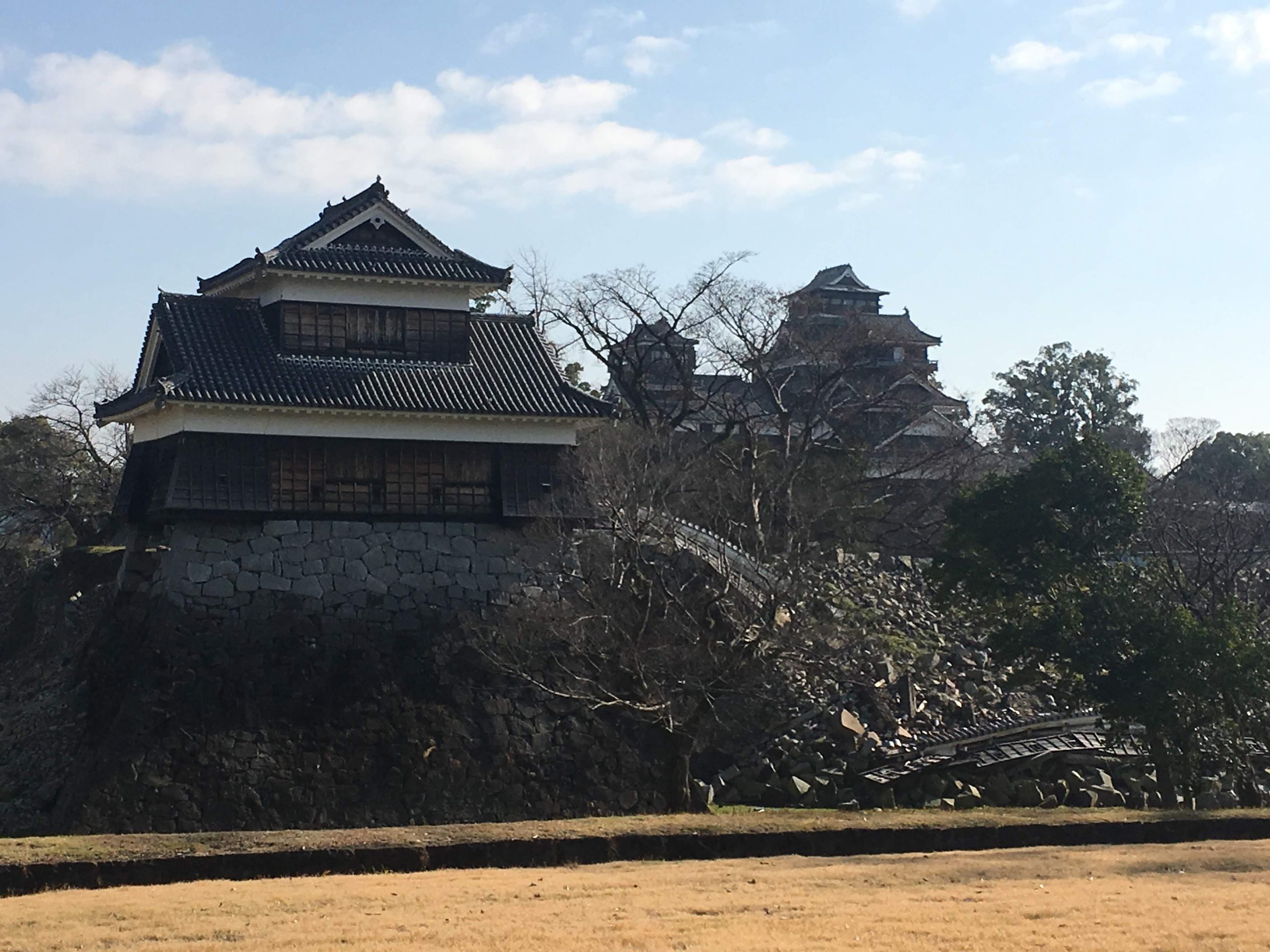
As I approached Kumamoto Castle, its sheer scale and visible wounds struck me immediately. The 2016 earthquake caused massive devastation here. Specifically, it collapsed stone walls and damaged historic towers.


The site did not look like a tidy restoration area. Instead, it felt like the visible memory of a disaster. Standing near the fallen walls, the reality of distance became clear. Photos often flatten collapsed masonry into an abstract image. In contrast, standing here made the stone piles feel physically heavy. These were not just broken walls; they were proof of undeniable force, of time violently interrupted.
That was what stayed with me the most. Kumamoto Castle did not feel like a polished tourist landmark pretending nothing had happened. It felt like a place enduring its own history in public. There was something deeply moving about that quiet honesty.
The Most Beautiful Castle View Is from Kato Shrine
If you continue walking along the damaged walls, the path leads naturally toward Kato Shrine. This Shinto sanctuary sits right beside Kumamoto Castle and is famous for offering one of the absolute best, unobstructed views of the main keep.

The view from the shrine grounds felt almost impossibly balanced. After the roughness of the earthquake damage, this was the exact opposite impression: not ruin, but form. Not collapse, but symmetry. For a moment, the castle looked beautifully complete again.
And then there was a small scene that deepened the moment even more. A couple in elegant traditional dress—a vibrant kimono and formal hakama—were taking wedding portraits nearby. Their presence softened everything. Against the dark, imposing mass of the fortress, they looked bright and fleeting, acting as a quiet reminder that life does not stop simply because a place has known hardship.
Inside the Shrine: Everyday Life Continues in Silence
It would have been easy to stop at the viewpoint and leave, but I walked a little farther into the shrine grounds. The mood changed immediately. Kato Shrine was not just a scenic photo spot beside a castle; it was still very much a living, breathing sacred space.

When I visited, an actual prayer ritual was underway. Several people were seated quietly, watching as a Shinto priest moved through the ceremony with practiced grace. Outside, the castle grounds spoke of rupture and repair. Inside, time flowed differently—steady, undramatic, and unbroken.
That contrast stayed with me long after I left. If Kumamoto Castle held the frozen shock of the earthquake, Kato Shrine seemed to hold continuity. Not grand, symbolic continuity, but just the ordinary kind. People still came here to pray. Ceremonies still happened. Daily life simply moved forward.
A Wider View from Above
After walking around the castle grounds, I wanted to understand the site as a whole. For that, the free observation deck on the 14th floor of Kumamoto City Hall is well worth the short walk. From there, the staggering scale of the castle complex becomes remarkably clear.

From ground level, the main keep dominates everything. From above, you register the broader composition. You notice sweeping stone ramparts, open grounds, and restoration frameworks. Moreover, soft mountain ridges rise gently in the distance.
Looking out over the city, the next stage of my trip took shape. The distant peaks seemed to point toward Mount Aso. The mountains beyond seemed to gently point toward Aso, where I would head the following morning.
Final Reflections on Kumamoto’s Resilience
Kumamoto was not the loudest stop on this road trip. However, it left a deep, lasting impression. Kumamoto Castle stands out because of its visible resilience. It is no longer just a damaged landmark, nor a fully restored monument. It exists in between—and visitors enjoy the rare privilege to witness that healing process.
I always travel with a camera because places like this are hard to keep only in memory. If a certain view or moment in this post stayed with you, I’d love to hear about it in the comments below. Or, please feel free to pour a cup of coffee and wander through more photo-rich travel essays right here on timidtravelers.com.
If you are starting this drive from Fukuoka, my Nagasaki half-day itinerary makes a gentle first stop before arriving in Kumamoto.
After the city and the castle grounds, the journey opens up dramatically in my Aso road trip guide, where the route shifts from stone walls and tram signals to caldera views and volcanic grasslands.
For the bigger picture, you can also read my full Kyushu road trip itinerary, where Kumamoto sits between the harbor calm of Nagasaki and the raw landscapes of Aso.

Leave a Reply