If you are wondering whether the St. Petersburg Metro is worth exploring as a traveler, my answer—especially as someone who prefers quiet observation over bustling crowds—is an emphatic yes. This is not merely public transportation. It is a spectacular half-day experience in its own right: part architecture tour, part history lesson, and part sanctuary for the solitary wanderer. For the timid traveler weary of overwhelmingly loud sights, it is one of the most rewarding places to spend a few hours.
Opened in 1955, the St. Petersburg Metro carries more than just daily commuters; it harbors the city’s collective memory of survival and restoration following the devastation of World War II. Built deeper than almost any other subway system in the world to bypass the city’s marshy foundation, the journey begins not on the platform, but on a dizzying, seemingly endless escalator. As the rush of cold subterranean wind hits your face, it feels as though the city is gradually folding itself closed above your head.

A Curated Half-Day Route for the Quiet Observer
If you want to absorb the sheer architectural magnitude of these stations without exhausting yourself in transit, an efficient route is essential. By moving sequentially between Line 1 (Red) and Line 5 (Purple), you can witness the best of the metro’s ornate decorations.
Here is a simple, deeply satisfying sequence that can easily be enjoyed in about two hours, even with plenty of time factored in for photography: Pushkinskaya → Zvenigorodskaya → Admiralteyskaya → Sportivnaya.
Why this specific route works so well:
- Minimal Backtracking: One station flows naturally into the next, saving your energy.
- Visual Variety: A curated mix of classical chandeliers, imposing mosaics, and unique single-vault architecture.
- Seamless Transfers: Easy, logical connections between lines.
- A Paced Experience: It feels less like a frantic checklist and more like walking through a subterranean art gallery.
💡 The Timid Traveler’s Transit Tip: Rather than fumbling with cash to buy an individual metal token (zheton) every time you ride, purchase a rechargeable Podorozhnik card. It saves you from awkward interactions at busy ticket windows and offers slightly discounted fares.
Pushkinskaya: Where Poetry Sits in the Shadows
The station that held my gaze the longest was our starting point: Pushkinskaya. At the far end of the dimly lit hall sits a pristine white statue of the revered Russian poet, Alexander Pushkin. From a distance, it blends into the station’s classical architecture. But as you draw closer, the atmosphere distinctly shifts.


There was something deeply still about that corner. Commuters kept moving, footsteps echoed, and trains roared past, yet the air around the statue seemed to move at a fraction of the speed. I noticed delicate, brightly colored flowers resting quietly on the cold marble—anonymous tributes left by passing locals. In that moment, seeing literature placed so intimately inside an ordinary daily space, I truly understood why St. Petersburg is known as a city where culture is woven into everyday life.
📷 Photography Tip: Patience is your best friend here. Wait for a train to depart, and you will be rewarded with a magical 1-to-2-minute window where the platform empties out, allowing for a perfectly solitary shot of the statue.
Zvenigorodskaya: A Grand Narrative in Transit
One of the great pleasures of the St. Petersburg Metro is that even the transfer corridors feel theatrical. Moving from Pushkinskaya to Zvenigorodskaya, I had the strange feeling that the architectural story was simply continuing into the next room.


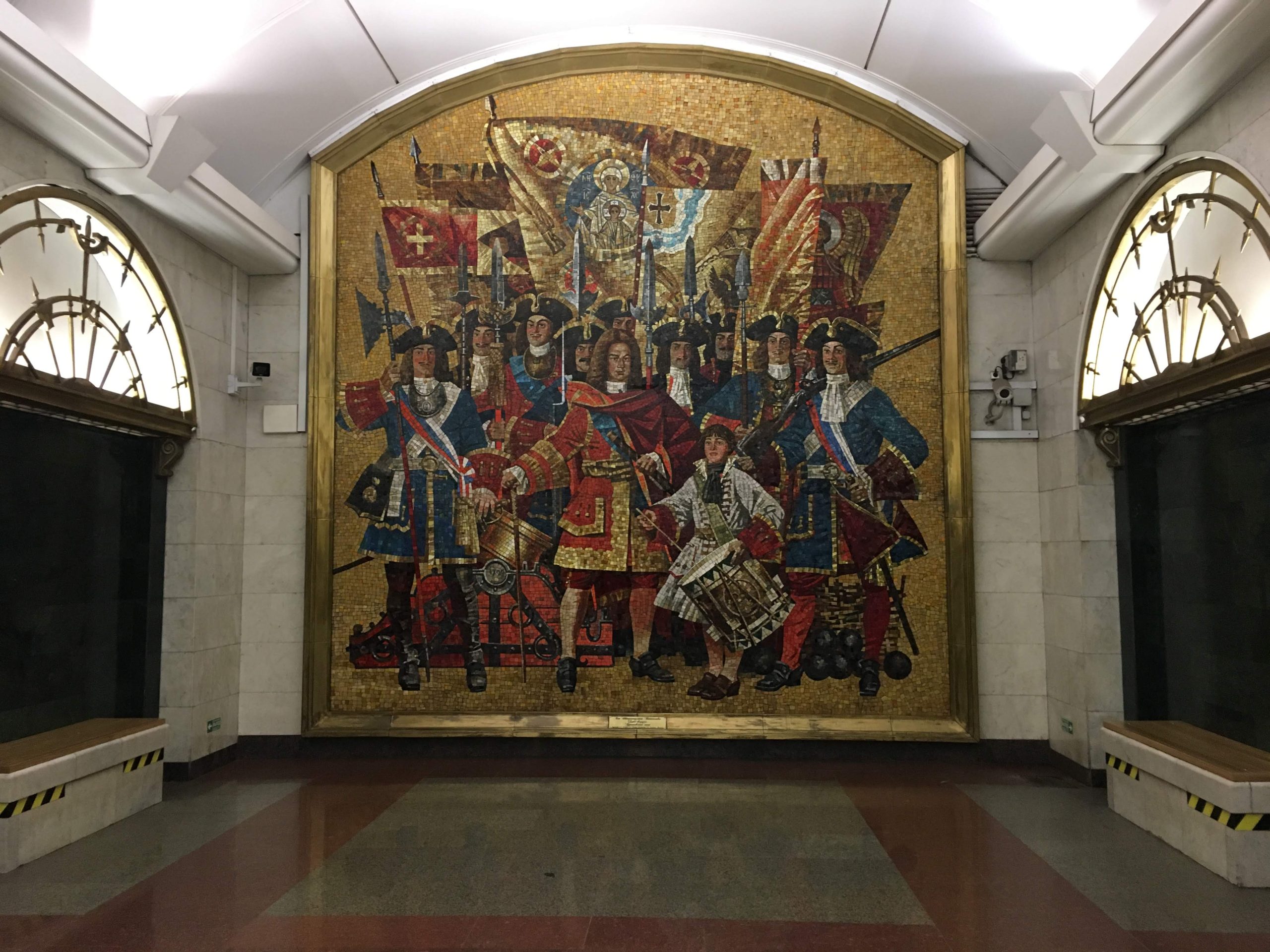
At Zvenigorodskaya, the undisputed highlight is a colossal mosaic depicting the imperial guards of Peter the Great. That is what makes this station so memorable: this overwhelming sense of grandeur feels almost misplaced in the best possible way. A monumental work of art that belongs inside a royal palace sits quietly in the middle of a pedestrian transfer route. It is delightfully surreal.
Admiralteyskaya: The Bottom of the Sea
Boarding Line 5 again, we ride to Admiralteyskaya—the station that makes the word deep feel profoundly real.
To reach the platform, you must ride a two-stage escalator descent down roughly 86 meters (282 feet) below ground. It is long enough for the city above—the snowy river embankments, the museum crowds—to completely fade from your mind.

Inside, the station glows with cool, aquamarine tones that call to mind the sea. Adorned with nautical anchors and maritime reliefs, the space is entirely shaped by St. Petersburg’s deep relationship with water. It feels less like a transit hub and more like an elegant, sunken submarine.
- Bonus Note: When you finally resurface, you will find yourself exceptionally close to the Hermitage Museum, making this station a perfect bridge between underground exploration and above-ground sightseeing.
Sportivnaya: An Underground Monument
The final stop, Sportivnaya, is an architectural anomaly that feels fundamentally different from the rest of the network.
Unlike a standard layout, it was designed as a massive, two-level, single-vault station. Standing on the lower platform, I had the odd sensation of being inside a newly unearthed subterranean cathedral rather than a transport hub.


At one point, I noticed a “No Boarding” sign. Stripped of moving trains, the station suddenly looked like a paused exhibition hall. Under the warm, yellow-toned ceiling, the empty platform felt hauntingly beautiful. The beauty here is less ornate than Pushkinskaya’s, but perhaps more profound because of its heavy, echoing silence. I kept pressing the shutter, trying to capture that unfamiliar tranquility.
🚶 Navigational Tip: Sportivnaya is a labyrinth. The upper and lower halls are split, and an underground travelator runs directly beneath the Neva River, dividing the exits. Check your Google Maps before you go underground to decide which exit you need to avoid a confusing detour.
There is a unique poetry in a city whose beauty does not stop at the pavement. For travelers who enjoy quiet observation, simply following the Cyrillic signs and letting the crowds pass you by will reveal the beating heart of St. Petersburg far beneath its gilded spires.
Thank you so much for wandering through the quiet depths of the St. Petersburg underground with me. As someone who finds the most joy in viewing the world through a camera lens, I’d love to know—which of these stations would you most want to photograph? Leave a comment below, and if you enjoyed this slower pace of travel, please feel warmly invited to grab a cup of tea and explore the other travel essays and photo galleries here on the blog. Safe travels!
For a quieter street-level introduction to the city, read my Vasilievsky Island walking route guide, which works especially well on your first day in St. Petersburg.

Leave a Reply