Remembering the Temperature of an Unfamiliar City
It takes just over an hour by plane to leave the lush humidity of Yangon behind. As the rhythmic hum of the twin propellers finally faded into silence on the tarmac, I stepped out into the air of Mandalay. It was surprisingly dry. Instead of the heavy, moisture-laden blanket of the south, a warm breeze laced with the nostalgic scent of sun-baked earth came out to greet me.
Leaving the airport and venturing into the heart of the city, a veil of pale, powdery dust began to blanket my view. The roads were a chaotic symphony of motorbike horns and rushing tires. Yet, amidst this seemingly untamed current of traffic, the locals moved with an unbothered, stoic grace, calmly navigating their own paths.
Instead of towering glass skyscrapers, the streets are lined with low, deeply weathered buildings that whisper of decades past. And there, springing up unexpectedly from the narrow gaps between mundane shops and homes, are magnificent golden spires. Mandalay is a place where the divine mingles casually in the very center of a boisterous, everyday life. As someone who usually shrinks away from loud crowds, I found myself surprised; the chaotic noise of this unfamiliar city didn’t bother me at all.
With barely enough time to unpack my bags, I stepped right back out into the dusty streets. In a city like this, perhaps it is faster to use the sharp, golden peaks of the pagodas as your compass rather than relying on a digital map.
Gilded Faith: An Afternoon on Mandalay Hill
To ascend Mandalay Hill, I slipped into the shadowed refuge of a long, covered corridor. Walking up the stepped pathway, the smooth tile beneath my bare feet shifted constantly in temperature—a startlingly cool relief in the deep shade that quickly melted into a lukewarm embrace where the sun managed to peek through.

The pathway up Mandalay Hill, where the cool shade of the roof dances with the blinding tropical sun.As I neared the summit, the sweeping view of the city finally cracked open. In Myanmar, the strict rule of removing both shoes and socks before entering any sacred space felt terribly vulnerable to a timid traveler at first. But soon, I realized it was a gift. You stop relying solely on your eyes; instead, you begin to memorize the sacredness of a place through the intimate temperature of the stone against your soles.
I stepped into the Su Taung Pyi Pagoda. Through the impossibly intricate, brightly colored walls, a pristine white Buddha looked down with a soft, benevolent gaze. The walls were encrusted with thousands of tiny glass mosaics, catching the fierce afternoon sunlight and fracturing it into a dazzling, almost surreal glow. I stood quietly, letting myself blend into the gentle hum of the local worshippers, just absorbing the shimmering light.

Inside Su Taung Pyi Pagoda, where a white Buddha sits enshrined in a mesmerizing world of glass mosaics.Descending the hill, my next refuge was the Sandamuni Pagoda. Here, a seemingly infinite forest of stark white stupas, each crowned with a delicate golden spire, stretches out in perfect geometric harmony. Walking through these orderly, blindingly white corridors gently dulls your sense of reality. The sheer contrast of the golden tips piercing the vast, cloudless blue sky is nothing short of breathtaking.

Sandamuni Pagoda, an endless, orderly forest of brilliant white and gold.Cities Left Behind by Time: Sagaing and Inwa
Crossing the great river, I climbed the gentle slopes of Sagaing Hill. Stepping into the crescent-shaped gallery of the U Min Thonze Pagoda, I was met with a beautifully rhythmic sight. Forty-five identical Buddha statues sit peacefully in a curved row, framed by soft, pastel-toned archways. Rather than feeling overwhelmingly majestic, it has a charming, almost dollhouse-like intimacy. Through the arched windows, I watched the muddy, life-giving waters of the Irrawaddy River flow by at a lazy, unhurried pace.

The beautiful curved gallery of U Min Thonze Pagoda, home to forty-five serene Buddhas.Later, I boarded a small wooden ferry to reach the ancient imperial capital of Inwa. Clambering into a rattling, horse-drawn cart, the smell of dry earth grew thicker as hooves kicked up clouds of dust along the unpaved village roads.
Our cart halted before the Maha Aung Mye Bonzan Monastery. While traditional Burmese monasteries were built from intricately carved teak wood, this 19th-century structure was commissioned by a queen using brick and stucco. Time has not been perfectly kind to the “Brick Monastery.” The pale yellow plaster is peeling, revealing blackened, weather-beaten stone beneath. The heavy masonry mimics the delicate floral carvings of wood, giving the massive structure an air of profound, melancholic grandeur.

The heavy, melancholic grandeur of the brick-built Maha Aung Mye Bonzan Monastery.Back in the cart, we bumped along the dirt paths, passing nameless, forgotten ruins slowly being swallowed by nature. We finally stopped at the Yadana Hsemee complex. Between ancient brick pillars whose roof had long since vanished into history, a solitary Buddha sat exposed to the elements.
Just crumbling brick walls, towering, stoic palm trees, and a perfectly still statue. For an introverted soul who often feels drained by excessive opulence, this quiet, unpolished, and static landscape was exactly what I needed. It was here that my footsteps lingered the longest.

Yadana Hsemee in Inwa—a place where a quiet Buddha and ancient palms keep watch over the ruins.The End of the Day: U Bein Bridge
As the relentless sun finally began its descent, I arrived at my last destination for the day: the U Bein Bridge in Amarapura.
Spanning an impressive 1.2 kilometers across Taungthaman Lake, it holds the title of the longest teak wood bridge in the world. Legend says that around 1850, when the royal capital was relocated, the discarded teak pillars of the old palace were salvaged to build this very crossing. The ancient wood that once supported the weight of kings now humbly supports the weary footsteps of everyday people.
I walked out onto the bridge. The wooden railings, battered by over a century of monsoon rains and blistering heat, were parched and heavily grooved. I ran my hand along the timber, feeling its dry, prickly texture. Creak, creak. With every step, I could hear the ancient wood groaning softly beneath me.

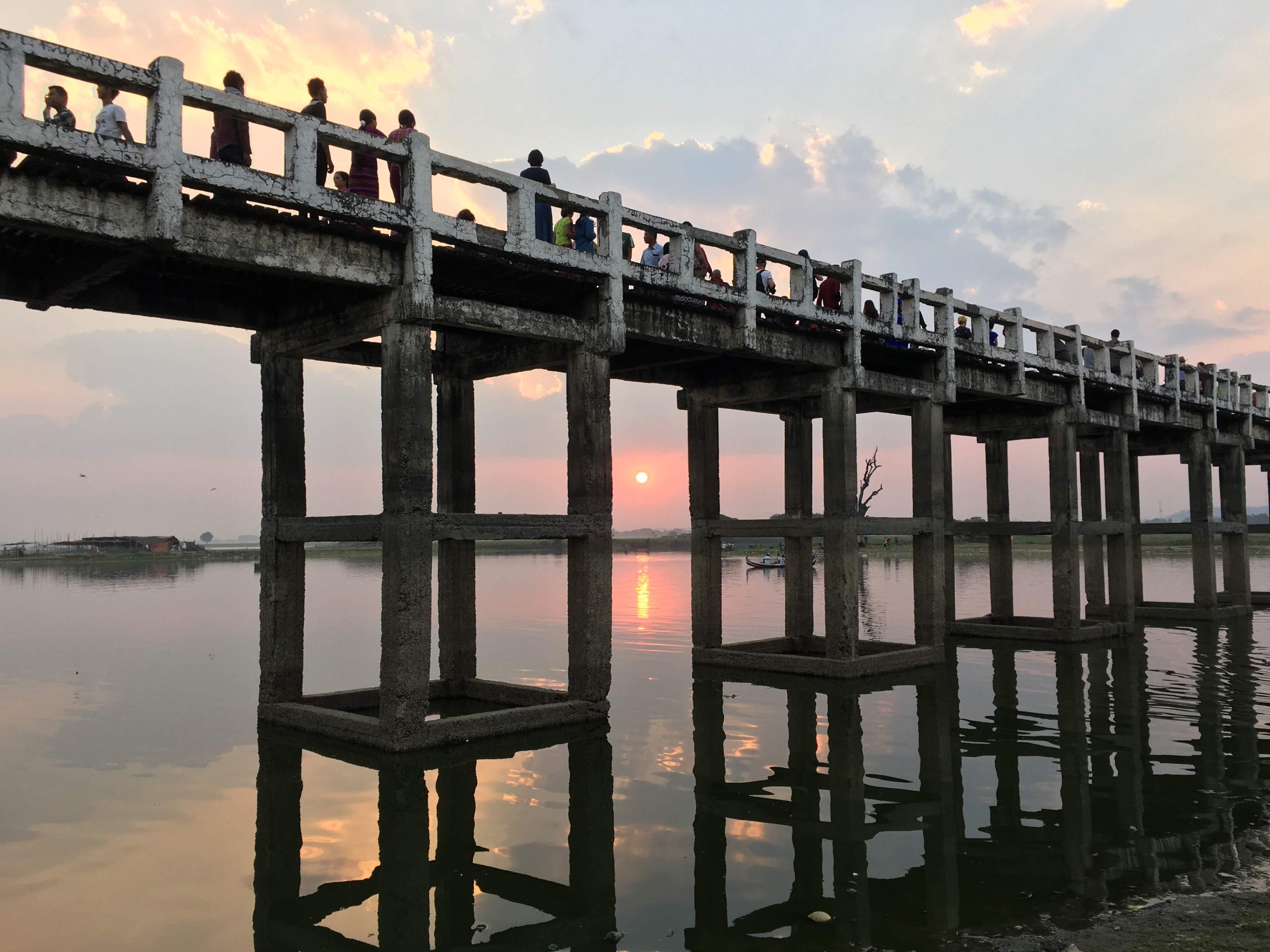
The textured, weathered teak of U Bein Bridge, silently bearing the weight of history.Covered in a day’s worth of fine dust, I made my way down to the banks below the bridge, finding a quiet patch of grass to wait for the sun to disappear. The lake’s surface slowly caught fire, shimmering with brilliant hues of crimson and burnt orange. Above me, the silhouettes of monks, villagers, and travelers walking across the bridge stretched out into long, elegant shadows.
It was only when the sky bruised into a deep, velvety violet that the physical exhaustion of the day finally washed over me. It was a heavy, but incredibly comforting lethargy.

Sunset at U Bein Bridge, where the sky burns red and the world falls beautifully silent.Mandalay Travel Guide (The Timid Traveler’s Memo)
If you are planning your own barefoot journey through this spiritual city, here are a few practical tips to help you navigate with ease.
1. Getting Around:
- City & Outskirts Tour: The three ancient capitals of Mandalay (Sagaing, Inwa, and Amarapura) are spread quite far apart. The most efficient, stress-free method is to hire a private taxi for the day. Expect to pay around 40,000 to 50,000 Kyat (MMK), though friendly haggling is expected. Asking your hotel to arrange a trusted driver is usually the safest bet.
- Yangon to Mandalay: A domestic flight is highly recommended to save time, taking only about 1 hour and 20 minutes.
2. Time Management:
- Exploring the three ancient capitals will take a full, exhausting, but rewarding day. Start early!
- Golden Rule: You must time your visit to the U Bein Bridge for sunset (usually between 5:00 PM and 6:00 PM). It is unequivocally the most magical moment of the day.
3. Costs & Tickets:
- Mandalay Zone Ticket: You will need to purchase a unified archaeological ticket for 10,000 Kyat (roughly $10 USD). Keep this on you at all times, as it grants access to most major historical sites.
- Navigating Inwa: To reach Inwa, you must take a quick ferry across the river (about 1,000 Kyat round trip). Once on the island, the distances are vast and the sun is hot, so hiring a traditional horse cart (around 15,000 Kyat per cart) is the standard and most charming way to get around.
4. Dress Code & Etiquette:
- Barefoot is Mandatory: In Myanmar, you must remove both shoes and socks before stepping onto the grounds of any temple or pagoda. Pro tip: Pack a small packet of wet wipes in your day bag to clean your feet before putting your shoes back on!
- Modest Clothing: Sleeveless shirts, shorts, or skirts above the knee will restrict you from entering sacred sites. Do as the locals do and buy a beautiful traditional Longyi (a wraparound skirt worn by both men and women) at the local market. It’s incredibly breathable in the heat and looks fantastic in photographs!
5. Essential Tips:
- Once the sun dips below the horizon at U Bein Bridge, the surrounding area gets pitch black very quickly. Make sure to head back to your pre-arranged meeting spot with your driver before it gets entirely dark.
- Cellular data can be notoriously spotty around the ancient ruins. Downloading an offline map via Google Maps before leaving your hotel is absolutely essential.
As much as I love getting lost in the history of these ancient places, my true joy comes from capturing their quiet, fleeting moments through my camera lens. Did you have a favorite photo or moment from this journey through Mandalay? I would love to read your thoughts in the comments below!

Leave a Reply